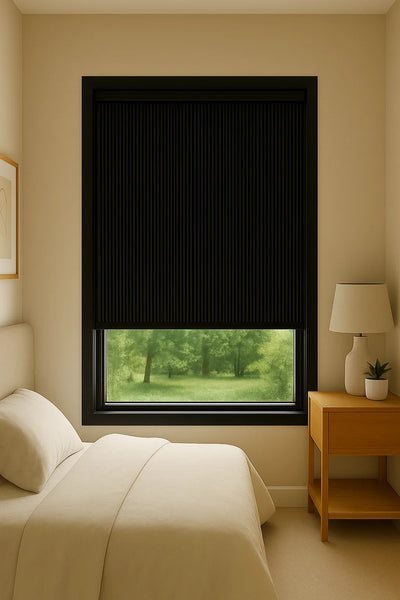
Vertical blinds are window blinds made of long fabric or PVC slats (also called louvres or vanes) that hang from a track at the top of the window. You turn the slats to control light and privacy, and draw them to one side to open the window fully. They are the best choice for wide windows, patio doors and bay windows, and at 1ClickBlinds every vertical blind is made to measure.
Our vertical blinds come in hundreds of colours and fabrics, from soft light-filtering weaves to blackout fabrics and wipe-clean waterproof PVC. Choose your fabric, enter your size and we make the blind to fit your window.
Vertical blinds: the quick answer
- What they are: long slats on a headrail that turn and slide sideways.
- Best for: wide windows, patio doors, French doors, bifolds, bay windows, conservatories and offices.
- Slat types: light-filtering fabric, blackout fabric and blackout waterproof PVC.
- Standard slat width: 89mm (3.5 inches), the most common size in UK homes.
- Made to measure: built to your exact width and drop.
- Easy to repair: damaged slats can be replaced one at a time with replacement vertical blind slats.
Types of vertical blinds
| Slat type | Light control | Best rooms | Good to know |
|---|
| Light-filtering fabric | Softens daylight and cuts glare | Living rooms, dining rooms, offices | Widest choice of colours and textures |
| Blackout fabric | Blocks light through the fabric | Bedrooms, nurseries, TV rooms | Close and overlap the slats for the darkest room |
| Blackout waterproof PVC | Blocks light and wipes clean | Kitchens, bathrooms, utility rooms, patio doors | Resists moisture and steam, does not absorb smells |
Need a dark bedroom? See our full range of blackout blinds. For kitchens and bathrooms, browse waterproof blinds.
Where do vertical blinds work best?
| Window or door | Why vertical blinds suit it |
|---|
| Patio and sliding doors | The slats stack to one side, so you can walk straight through. See sliding door blinds. |
| French doors | Full-height cover when closed, clear doorway when open. See French door blinds. |
| Bifold doors | One long track covers the whole run of glass |
| Wide and picture windows | The track spans wide openings without sagging |
| Bay windows | A separate blind for each section of the bay. See bay window blinds. |
| Conservatories | Control strong sun and glare across lots of glass |
| Offices and meeting rooms | Angle the slats to stop screen glare without losing daylight |
Why choose vertical blinds?
- Precise light control: turn the slats to let light in, angle it away from screens, or close them for privacy.
- Privacy with daylight: angle the slats to block the view in from outside while still letting light into the room.
- Space saving: they stack neatly to the side and need far less wall space than curtains.
- Great value for big windows: one blind can cover a wide window or patio door.
- Easy to clean: dust the slats or wipe PVC slats with a damp cloth.
- Easy to repair: replace a single damaged slat instead of the whole blind.
Vertical blinds vs other window coverings
| Vertical blinds | Roller blinds | Curtains |
|---|
| Wide windows and patio doors | Excellent | Can be heavy and bulky at large widths | Good, but need wall space to stack |
| Light control | Turn slats to any angle | Up or down only | Open or closed only |
| Open from the side | Yes | No | Yes |
| Space needed when open | Small stack at the side | Rolls up at the top | Large stack at each side |
| Repairs | Replace single slats | Replace the whole blind | Re-hang or replace |
Still deciding? Read vertical blinds vs curtains.
How to measure for vertical blinds
First decide where the blind will go: inside the window recess, or outside it on the wall or ceiling.
Inside the recess
- Measure the width of the recess at the top, middle and bottom. Use the smallest number.
- Measure the drop at the left, centre and right. Use the smallest number.
- Check the recess is deep enough for the headrail and that the slats can turn without hitting handles.
Outside the recess
- Measure the width you want to cover. Add extra on each side so the blind overlaps the window and stacks clear of patio doors.
- Measure the drop from where the track will sit to where you want the blind to finish. Leave a small gap above the sill or floor so the slats do not drag.
Use a steel tape measure and measure in millimetres. Follow our step-by-step guide on how to measure for vertical blinds.
Vertical blinds by room
- Living room: light-filtering fabric slats soften sunlight and reduce TV glare.
- Bedroom: blackout slats darken the room for better sleep. Fit them outside the recess for the least light around the edges.
- Kitchen: waterproof PVC slats wipe clean and do not hold cooking smells.
- Bathroom: PVC slats handle steam and give privacy with daylight.
- Conservatory and garden room: manage strong sun across lots of glass.
- Home office: angle the slats to stop screen glare. Read why vertical blinds suit offices.
Vertical blinds for patio doors
Vertical blinds are the most popular choice for patio doors because the slats stack neatly to one side and leave the doorway clear. For the best result, fit the track 10 to 15cm wider than the door frame on each side so the stacked slats sit beyond the opening. For very wide doors, a split draw (slats opening from the centre to both sides) makes the blind easier to use. Read our guide to the best vertical blinds for patio and French doors.
Popular vertical blind colours
- White and cream: keep the room bright and suit almost any style. Shop white blinds.
- Grey: a calm, modern choice that hides everyday marks better than bright white. Shop grey blinds.
- Bold colours and patterns: add personality to a living room, kids room or office.
Not sure which colour to pick? Read how to choose the right colour vertical blinds.
Replacement vertical blind slats
If your headrail still works but the slats are faded, marked or broken, you do not need a whole new blind. Replace just the slats with our made-to-measure replacement vertical blind slats, as long as the slat width matches your headrail. See how to replace vertical blind slats.
How to clean vertical blinds
- Weekly: close the slats and dust them with a soft cloth or the brush tool of your vacuum.
- PVC slats: wipe with a damp cloth and mild soapy water, then dry.
- Fabric slats: spot clean gently with a damp cloth. Do not soak them.
Read our full guide on how to clean vertical blinds without taking them down.
Frequently asked questions
What are vertical blinds?
Vertical blinds are blinds made of long, vertical slats that hang from a headrail. The slats turn to control light and slide to one side to open the window. They suit wide windows and doors best.
Are vertical blinds good for windows?
Yes, especially wide windows, bay windows and conservatories. For small windows, a roller blind or venetian blind often looks neater.
Are vertical blinds outdated?
No. Modern fabrics, textures and colours make vertical blinds look clean and contemporary, and they are still the most practical choice for patio doors. Read are vertical blinds outdated?
Are vertical blinds made to measure?
Yes. At 1ClickBlinds every vertical blind is made to the width and drop you give us, so it fits your window or door properly.
Do vertical blinds block out light?
Blackout fabric and blackout PVC slats block light through the fabric. A little light can still show at the edges and where slats meet, so close them fully and fit the blind outside the recess for the darkest result.
Are vertical blinds good for bathrooms and kitchens?
Yes, if you choose waterproof PVC slats. They resist moisture and steam and wipe clean easily.
What width slats do vertical blinds have?
The standard width in UK homes is 89mm (3.5 inches). When you buy replacement slats, match the width of your existing slats.
Can you replace just the slats on vertical blinds?
Yes. If the headrail works, you can replace one slat or the full set with replacement vertical blind slats.
Should vertical blinds touch the floor?
No. Leave a small gap, about 1cm, above the floor or sill so the slats hang straight and do not collect dust or wear at the bottom.
Should vertical blinds go inside or outside the recess?
Inside the recess looks neat on windows with a deep recess. Outside the recess gives better light blocking and is usually best for patio doors, because the slats can stack clear of the opening.
Can you get no drill vertical blinds?
Vertical blinds are fitted with brackets because the headrail carries long slats. If you cannot drill, see our no drill blinds, which fit uPVC windows and doors with no screws.
How do you clean vertical blinds?
Dust the slats regularly with a soft cloth or vacuum brush. Wipe PVC slats with a damp cloth and spot clean fabric slats gently.
How much do vertical blinds cost?
The price depends on the size of your window and the fabric you choose. Enter your width and drop on any product page to see your exact made-to-measure price.
Can you fit vertical blinds on bifold doors?
Yes. One long track can cover the full width of a bifold door, and the slats stack to one side so the doors can fold open. Read vertical blinds for bifold doors.
Do vertical blinds keep heat in?
Closed vertical blinds add a layer between the glass and the room, which helps reduce draughts and heat loss on big windows. Blackout and thicker fabrics work best. Read about thermal vertical blinds.
What is the difference between vertical and venetian blinds?
Vertical blinds have long slats that hang down and slide sideways, so they suit wide windows and doors. Venetian blinds have horizontal slats that lift up, so they suit smaller windows. Compare venetian vs vertical blinds.
Can I order a sample?
Yes. Order a sample of your chosen fabric to check the colour and feel in your room before you buy.
Explore more: thermal blinds, day and night blinds and roman blinds.

 Skip to content