Skip to content


Clip In Blinds Against Tension and Adhesive: Three No Drill Fittings Compared
- by Mariam Labadze
Clip in blinds grip the glazing bead, the slim strip of plastic that pins the glass into a uPVC sash, and that one fact decides where they can go. Tension rods push outward against the side walls of a recess instead. Adhesive brackets stick to whatever surface you give them. Three fittings, three ways of failing, and only one can pull paint off your reveal.
Listings describe all three as no drill and stop there. The differences only surface after a blind has hung through a season.
Key Takeaways
-
Clip in blinds need a bead. A square-faced glazing bead on a uPVC frame is the requirement, and aluminium rarely offers one.
-
Tension wants depth and square. A deep, true recess holds a rod; a shallow or splayed one lets it creep down the wall.
-
Adhesive is the damaging one. It mounts anywhere, and it is the only fitting that takes paint, paper or plaster with it.
-
Weight beats width every time. Clips, rods and pads all fail the same way, under a lined fabric rather than a wide one.
-
Your leaving date decides. A year in a rented flat and a decade in your own house point at different brackets.
What Clip In Blinds Grip, and What They Need
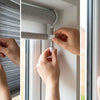
Look at the inner edge of a uPVC window. The strip of plastic holding the glass in, standing proud of the sash, is the glazing bead. Clip in blinds use a sprung bracket that hooks over it, top bead to bottom, so the frame carries the blind and nothing goes into the wall.
The result is the tidiest of the three. The blind sits in the plane of the glass rather than the recess, so it travels with the opening casement, the sill stays usable and the reveal walls are untouched. That is why clip in blinds are the standard answer in a rental that bans fixings.
They need a bead with a square face and enough depth for the bracket to bear against. Older uPVC with a rounded or chamfered bead gives the clip nothing flat to sit on, so it either refuses to go on or rocks. Aluminium frames have nothing resembling a bead, and timber sashes do not either.
Measure the bead before you order, depth and face shape both. That check prevents nearly every clip in blinds return.
Product naming is loose. Clip on blinds, clip in blinds and clip on shutter blinds often describe the same bracket, and some sellers switch terms inside one listing. Judge the photograph of the bracket, not the words above it.
Panel systems lean on that bead harder. Whether a seller calls them clip in shutter blinds or something else, louvred versions weigh more than fabric and ask more of the plastic. The frame used by perfect fit blinds spreads that load across all four sides, which is the sensible route for anything with slats.
Tension Rods: Cheap, Fast and Limited
A tension rod is two tubes and a spring. You compress it, set it between the side walls of a recess, release, and friction holds it. Nothing touches the frame, nothing clips to anything, and the whole job takes a minute.
Where the recess suits it, it works. A deep opening with square, plastered reveals gives the rod two parallel faces to push against, and a light fabric on a short drop stays up without attention. It is the only fitting here that leaves no trace at all.
Where it fails is predictable. A shallow recess has nothing to grip. A splayed reveal means the rod is pushing at an angle, so it slides from the day you fit it, slowly enough that you blame the blind. Gloss paint is slippery, and a tiled bathroom recess is the classic place to find a rod on the floor.
Weight is the sharper limit. A voile sits happily on a rod. Add a lining, a wider drop or a side chain and the rod takes a twisting load it was never designed for, which drives one end down the wall. Tension suits a small, deep, square recess with a light fabric, and nothing beyond that.
Adhesive Brackets: The One That Damages Things
Adhesive brackets are a foam pad with a bracket moulded on. Clean the surface, peel, press, wait, then hang. There is no bead requirement and no recess requirement, which is the entire appeal: adhesive mounts in places where clip in blinds have nothing to hold and a rod has nothing to push against.
It is also the only one that can leave damage behind. On glass or uPVC, careful removal with gentle heat comes away clean. On painted timber, on wallpaper, or on a reveal where emulsion was rolled over old emulsion, the tape lifts the surface with it. Tenants find this out on moving day, which is the worst possible day for it.
Heat and damp are the other weaknesses. A bathroom, a spot above a radiator or a south-facing conservatory all soften the pad, and a soft pad creeps rather than snapping, so the blind hangs crooked for a fortnight before it drops. Clean the surface with something that leaves no residue and give the tape its full curing time. Most adhesive failures are impatience, not bad tape.
Which Windows Rule Each Option Out
Work backwards from the window and the choice usually makes itself.
Aluminium frames rule out clip in blinds immediately, because there is no bead to grip, and push you towards adhesive on the glass or a rod in the reveal. Rounded uPVC beads do the same less obviously: the bracket goes on, rocks, and works loose. A shallow recess rules out tension, and a tiled or gloss reveal rules it out again.
Timber sash windows are awkward for all three. The reveal is often deep enough for a rod, which is the usual answer, but painted timber is exactly the surface adhesive damages most.
Tilt and turn casements are the clearest case. Anything in the reveal fouls the opening leaf, so the blind has to travel with the sash, which means clip in blinds or a frame system. Lightweight pleated blinds in a clip frame are the usual answer, because the fabric stacks tight and clears the handle.
Darkness is where all three disappoint equally. Light runs around the edge of any blind that is not channelled, and no drill fittings hold fabric near the glass without sealing it. Clip on blackout blinds get closest, since the fabric travels inside the frame line, but for a genuinely dark bedroom you are comparing these against channelled blackout blinds rather than hoping one of them matches.
Choosing by How Long You Are Staying
Think about the day you take the blind down, not the day you put it up.
In a short tenancy the only question is what comes off without a conversation. Tension leaves nothing. Clip in blinds leave nothing either, assuming the bead was the right shape and you did not force the bracket. Adhesive on glass is usually fine; adhesive on paintwork is a gamble.
In your own home the logic inverts. Permanence stops being a risk and becomes the point, and a screwed bracket beats all three for strength. The reason to stay no drill in a house you own is normally a frame you would rather not pierce, or a reveal too narrow for a fixing.
A fourth route is worth naming. Twist and fit brackets clamp into the recess itself rather than onto the frame, and they behave differently enough to deserve their own explanation.
For most people the decision comes down to the bead. If your frame has a square one, clip in blinds give the neatest result with the least to go wrong. If it does not, tension in a deep recess and adhesive on glass split the remainder between them, and the room you are fitting decides which.
Frequently asked questions
How do no drill blinds work?
Each system borrows an existing surface instead of making a new fixing. Clip in blinds hook a sprung bracket over the glazing bead on a uPVC sash. A tension rod expands between the side walls of a recess and holds by friction. An adhesive pad bonds to glass, frame or plaster. The load path differs in every case, which is why one window suits one system and refuses another.
What are no drill blinds?
They are ordinary blinds supplied with a bracket that mounts without screws, not a separate category of fabric. The headrail, the mechanism and the fabric are usually identical to the drilled version, and only the bracket changes. That means the choice is purely about how the blind attaches, so judge it on your frame material, your recess shape and whether the fabric is light or lined.
How do you remove blinds?
Take the weight first, then release the bracket. A clip bracket unhooks by pressing the sprung tab and lifting the blind away from the bead. A rod comes out by twisting it shorter. Adhesive needs patience: warm the pad gently, work dental floss or fishing line behind it, and pull slowly along the surface rather than away from it to avoid lifting paint.