Skip to content


Linen Roman Blinds: Texture, Drape and How the Fabric Behaves
- by Mariam Labadze
 Linen roman blinds are Roman blinds made from linen or a linen blend, prized for a soft, natural texture and a relaxed drape. Real linen creases and moves with humidity, which is the character of the material rather than a fault, so expect a lived in look rather than a crisp, machine perfect one. Knowing that before you buy is the difference between delight and disappointment.
[toc]
This is a fabric decision more than a style decision. Once you understand how linen behaves, what a blend fixes and what it costs you, and how to care for it, you can choose with confidence. So we will treat the fabric as the star and work through it honestly.
Key Takeaways
-
Creasing is the material, not a defect. Real linen relaxes and wrinkles softly, which is the texture people buy it for.
-
A blend trades character for calm. Adding cotton or polyester reduces creasing and stabilises the fabric, at the cost of some of linen's slubby character.
-
Drape is looser than cotton. Linen folds with a soft, slightly irregular stack rather than a sharp, uniform pleat.
-
Lining changes everything. A blackout or thermal lining adds darkness and warmth and helps the folds hang more evenly.
-
Care is gentle and specific. Most linen Romans are best dry cleaned or spot cleaned, since washing can shrink and distort the fabric.
What Linen Roman Blinds Are, and How the Fabric Behaves
Linen roman blinds are flat fabric blinds that draw up into soft horizontal folds, cut from linen woven from flax fibres. The appeal is tactile. Linen has an uneven, slightly slubby surface that catches light in a way smooth cottons and synthetics do not, and it brings a natural, unforced look to a window. That texture is exactly why designers reach for linen roman blinds in rooms meant to feel calm and considered, a point our piece on why roman blinds are a designer favourite explores in more depth.
The same fibre that gives the texture also gives the behaviour. Linen is strong and breathable but not naturally springy, so it creases where it folds and softens as it settles. Understanding that from the start is the whole game with this fabric.
Why Linen Creases and Relaxes, and Why That Is Normal
Flax fibres do not have the natural elasticity of wool or the memory of many synthetics. When you fold linen, the crease stays, and when the blind hangs, the fabric gradually relaxes and softens along those lines. This is why a linen Roman looks a little different in the morning than it did when you dressed it the night before, and why the folds are never machine perfect.
Humidity plays a part too. Linen absorbs and releases moisture from the air, so in a steamy bathroom or a busy kitchen the fabric can move and soften more than it would in a dry lounge. None of this signals poor quality. A crisp, creaseless linen is usually a heavy blend or a treated fabric, not pure flax. If the relaxed look is what you want, the creasing comes with it, and the two cannot be separated.
Pure Linen Versus a Linen Blend
This is the choice that shapes everything else. Pure linen gives you the strongest texture and the most natural drape, along with the most creasing and movement. A linen blend, usually linen with cotton or a little polyester, keeps much of the look while calming the behaviour. The blend creases less, holds its shape better between folds and copes more happily with humidity.
What you give up in a blend is some of the slubby character and the way pure linen ages into a softer version of itself over the years. For a formal room where you want linen's texture but tidy folds, a blend is often the sensible call. For a relaxed, natural interior where a little irregularity reads as charm, pure linen rewards you. Neither is wrong, and made to measure roman blinds let you specify either against your exact window.
Drape, Fold and How They Hang
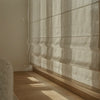
Linen folds with a soft, slightly loose stack rather than the sharp, uniform pleat you get from a stiff cotton. The bottom fold tends to be the fullest, and the folds above it sit with gentle variation. Adding rod pockets to the back of the blind, where thin rods hold each fold line, tightens the stack and keeps the folds even, which is worth specifying if you like more order.
Weight affects the hang. A heavier linen or a lined blind pulls the folds down into a cleaner stack, while a light unlined linen billows more and stacks loosely. On a tall window the extra weight of a lining genuinely improves how the blind sits. Bay windows are their own case, since each blind is made separately for its section and the set has to read as one; our bay window blind range shows how a run of blinds works together across the angles.
Colour and Pattern: Grey, White, Striped
Colour reads differently on a textured fabric. Grey roman blinds in linen soften a scheme without the flatness a smooth grey can bring, because the weave breaks up the colour and adds depth. Natural, oatmeal and stone tones are the classic linen choices, since they show off the fibre's character, but linen takes colour well across the range.
White roman blinds in linen give you a bright, airy window while keeping the warmth that a stark synthetic white can lack. Striped roman blinds work particularly well in linen, because the relaxed weave keeps the stripe from looking rigid or corporate and softens it into something easier to live with. Whichever you choose, remember that a strong crease can interrupt a bold pattern, so busy prints suit a blend better than pure flax.
Lining, Light and Warmth
Lining is where a linen Roman becomes practical as well as pretty. Unlined, linen glows softly when backlit and lets a fair amount of light through, which is lovely in a living room and useless in a bedroom. Adding a blackout lining behind the linen gives you darkness for sleep while keeping the linen face on show in the room, and our blackout blind range shows how a room darkening layer changes what a blind can do.
Warmth is the other gain. A thermal lining traps a layer of air against the glass and slows heat loss, turning a decorative blind into something that helps a cold room. You can see the backed fabrics in our thermal blind fabrics collection. A lining also adds weight, which as noted helps the folds hang more evenly, so it earns its place on looks as well as performance.
Honest Care Instructions
Care is where honesty pays off. Most linen roman blinds should be dry cleaned rather than washed, because linen shrinks and can distort if it gets wet and is not handled carefully. For everyday upkeep, vacuum the blind gently with a brush attachment to lift dust, and deal with marks promptly by blotting rather than rubbing.
If a blind is unlined and the fabric care note allows it, some pure linen can be hand washed cold and reshaped while damp, but expect shrinkage and plan to iron it back. Lined blinds should not be washed at all, since the face and lining shrink at different rates and pull the blind out of shape. When in doubt, dry clean. Linen roman blinds reward gentle, occasional care rather than frequent washing, so when you are ready to choose a fabric and colour, our roman blind range brings the linen options together in one place.
Frequently Asked Questions
Are roman blinds washable?
Some Roman blinds are washable and many are not, and it comes down to the fabric and the lining. Cotton and polyester Romans are often more forgiving, while linen and lined blinds usually need dry cleaning to avoid shrinkage and distortion. Always check the care label before wetting any fabric. For routine care, vacuuming with a soft brush and spot cleaning marks keeps most Roman blinds fresh without the risk that washing brings.
How do you remove roman blinds for washing?
To take a Roman blind down, raise it partway, then release the headrail from its brackets, which usually clip or screw at each end. Slide out the rods from their pockets and unhook the cords or chain so nothing tangles. Keep the rods in order for refitting. Remember that many linen and lined Romans should be dry cleaned rather than washed, so removal is often for cleaning around the window, not the fabric itself.
Are roman blinds fashionable?
Roman blinds remain a firm favourite in UK interiors and show no sign of dating, because the soft folds bring a warmth that a flat blind cannot. Natural fabrics like linen keep them current, and designers use them to add texture in living rooms and bedrooms alike. Made to measure roman blinds in a considered colour, from oatmeal linen to soft grey roman blinds, sit comfortably in both traditional and contemporary schemes.