Skip to content


Best Blinds for Bifold Doors: What Survives a Door That Folds Away
- by Mariam Labadze
The best blinds for bifold doors are the ones that still work on the day the doors are folded back, and that is the only test worth applying. A bifold run is not a window. It is a moving wall, and most blinds fail it in a way nobody warns you about until the stack is standing in front of your blind.
So rank the best blinds for bifold doors by what happens during the fold rather than by fabric or price. Three approaches survive it, each with a failure mode worth knowing before you order.
Key Takeaways
-
Judge it folded, not closed. Any blind looks fine on a shut door. The stack sorts the best blinds for bifold doors from the rest.
-
Above the run means clearing the stack. A headrail over the whole opening must sit clear of the folded leaves.
-
Leaf-mounted travels with the door. It never blocks the opening and it never gets in the way.
-
Vertical louvres cost opening width. The stack has to live somewhere, usually in front of glass.
-
Motorising is about width. On a long run, a manual chain at one end stops being usable.
The Only Test the Best Blinds for Bifold Doors Must Pass
Open the doors fully and look at what is standing in the opening. On an inward-folding set the leaves concertina back into the room and take up depth against the reveal. On an outward-folding set they sit outside, but the frame and handles still project. Whatever you fit has to not be in that space.
That rules things out quickly. A roller inside the reveal, a roman blind with a stacked fold, anything with a chain at one end: fine on a closed door, in the way of a folded one. Across the best blinds for bifold doors options, every workable approach answers the same question of where the blind goes when the doors are not there.
The second question is how often you open them. A run opened twice a summer carries a blind that would be a nuisance on one opened every morning.
Blinds Above the Whole Run
The first approach treats the opening as one window and hangs a single blind above it, outside the reveal on the wall or the ceiling. One blind, one measurement, one fabric line across the glass.
Two things have to be true. The headrail has to sit high enough and far enough forward that the folded doors pass beneath it, which usually means fixing to the ceiling or the lintel rather than the reveal. And the blind has to draw fully clear, because fabric hanging halfway down a folded bifold is in the way of anyone walking through.
A vertical track is the common version. vertical blinds hung above the run draw to one side in a single pull, faster than raising a wide roller, and they tilt for glare without opening fully. The failure mode is the stack: the louvres gather somewhere, usually in front of the glass at one end.
Blinds Fixed to Each Leaf
The second approach puts a separate blind on every leaf, fitted to the glass or the frame of the door. When the doors fold, the blinds fold with them. Nothing is ever in the opening, because the blind is part of the door.
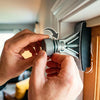
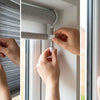
This is the approach that passes the fold test outright, and it is why perfect fit blinds for bifold doors are the usual recommendation on a run opened daily. perfect fit blinds clip into the glazing bead with no drilling, the frame holds the blind tight to the glass top and bottom so nothing swings as the door moves, and the handle stays clear.
The costs are real. One blind per leaf means a six-door run is six blinds and six operations every time you cover the glass. The frames are visible against the pane, which some people dislike on a door that is mostly view. And a clip-in frame needs a bead deep enough to take it, so check before ordering.
Vertical Louvres Stacked to One Side
Verticals deserve a second look, because they are the most common answer on wide bifold door blinds and the one with the most misunderstood trade.
The appeal is genuine. One track covers a run of any practical width, the louvres tilt to kill low evening sun without shutting the room off, and drawing them back takes one movement rather than six.
The cost is opening width. Stacked louvres take real space at the end of the track, in front of glass or frame, so the opening you paid for is narrower than it was. Splitting the draw so they gather half to each side halves the loss at each end but puts fabric on both. There is no version where the stack disappears.
Motorising a Wide Run
On a long run, the best blinds for bifold doors fail on a point nobody plans for: reaching the control. A chain at one end of a six metre track means walking the length of the room to adjust the glare, and people stop bothering.
That is the real argument for electric blinds for bifold doors, and it is practical rather than luxurious. motorised blinds move the whole run from one control, which makes a wide track usable in a way a manual one is not, and most systems work with a wall switch, a remote or a smart home assistant.
Weigh the downsides honestly. There is a motor and a power supply to site, easiest decided before the plastering is finished. Battery versions need recharging. And a motor is one more thing that can fail on a blind you already paid a premium for.
A sliding run is a different problem, since the doors pass each other rather than stacking forward, and patio door blinds built for a track can sit inside the reveal in a way bifold blinds cannot. Pick the best blinds for bifold doors by how often the doors open: daily, go leaf-mounted; occasionally, a vertical track is easier to live with; wide and daily, budget for the motor.
Frequently asked questions
What are the best blinds for french doors?
Blinds fitted to the door leaf itself, almost always. A perfect fit frame or a slim roller fixed top and bottom travels with the door and never swings against the glass, and the handle stays usable. A single blind hung above a pair of french doors works only if it clears the swing completely. Measure around the handle before you order, because that is the usual cause of a return.
How do perfect fit blinds work?
A slim frame clips into the rubber glazing bead around the pane, holding the blind tight against the glass with no screws and no drilling into the door. The fabric or the slats run inside that frame, held top and bottom, so nothing hangs loose or swings when the door moves. They need a bead deep enough to take the clips, so check the door before ordering.
How do you measure for vertical blinds?
For a track above the opening, measure the full width you want covered and add an overlap at each side, then measure the drop from the track to where the louvres should finish, usually just short of the floor so they hang free. For a recess fit, measure the width at three heights and use the narrowest. Decide which way the louvres stack before you order.