Skip to content


Keylite Blinds: Fitting a Roof Window That Is Not a Velux
- by Mariam Labadze
Keylite blinds are brand specific for one mechanical reason: the side channels that stop light escaping around a roof blind screw into the sash itself, and sash profiles differ between makers. A blind drawn around one frame has its fixing points in the wrong place on another. Before you pick a fabric, you need the code printed on your own window.
That code is the job. The rest is choosing a colour.
Key Takeaways
-
Keylite blinds follow one profile. The channels drop into a rebate shaped for one frame, so brand matters more than size.
-
Find the data plate first. A label on the sash carries the make, type and size reference you quote when ordering.
-
Measure only as a cross check. Different window types share glass sizes, so the code outranks your tape measure.
-
Each option mounts differently. Blackout, pleated and insect screens sit in different places on the frame.
-
Universal blinds work and look it. They fit almost anything, stand slightly proud, and suit a landing better than a bedroom.
Why Keylite Blinds Are Not Velux Blinds
A roof blind cannot simply hang. The sash tilts and rotates, so gravity no longer holds fabric against the glass, and the only answer is a tensioned system running in channels screwed down both sides of the frame.
Those channels are why keylite blinds and the equivalents made for other brands are not interchangeable. Screw positions, the depth of the rebate and the shape of the top cap are all drawn around one manufacturer's profile.
Search velux blinds uk and almost everything assumes one brand, which owns most of the installed base in British lofts. If your window is something else, the general advice written about blinds for velux windows still holds and the specifics do not. The principle is the channel. The detail is the screw hole.
Sellers file the whole category under skylight blinds, so the brand filter matters more than the fabric filter. Ordering keylite blinds means ordering against a reference, not a width and a drop.
How to Read the Code on the Frame
Open the window and rotate the sash until the top edge comes down where you can see it. On most roof windows the data plate sits there, on the top face of the sash, sometimes behind the ventilation flap, sometimes on the side near the pivot.
The plate carries the maker's name, a type reference and a size reference, as a short string of letters and numbers. Photograph it rather than copying it out: one transposed character buys a blind for somebody else's window. Suppliers of keylite blinds ask for that reference and little else.
Do not work backwards from the glass. Window types can share similar glass and take different blinds, and no tape measure separates them. Measure if you like, but treat the figure as a sanity check on the code, never a substitute.
If the plate has been painted over, or the loft was converted before you bought the house, the supplier is your next call. Send a photograph of the top of the sash with the frame profile in shot. Most can identify a window from it.
Blackout, Pleated and Insect Options for a Roof Window
Keylite blinds come in three broad types, and each sits in a different place on the frame.
Blackout is what most people are here for: a roof window faces the sky, and a bedroom under it gets light long before anyone wants it. A channelled roof blind gets closer to real darkness than anything on a vertical window, since the channels cover both fabric edges. On a standard window, blackout blinds rely on the recess instead and leak down the sides.
Pleated fabric is the daytime answer, filtering light rather than stopping it, and stacking into a small bundle at the head of the sash. It is the construction used by pleated blinds elsewhere in the house, carried in roof channels instead of a recess.
Insect screens mount separately, at the outer face or in the vent flap, and on many windows they live alongside a blind rather than instead of one. Check with the supplier first, because on some profiles both want the same fixing points.
Heat is the quiet fourth question. An internal blind is fighting the hardest window in the house, since glass angled at the sky collects more sun than any vertical pane. A lined or honeycomb fabric of the sort used in thermal blinds takes the edge off, but the real gains come from an external awning.
Fitting Overhead Without Standing on the Bed
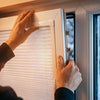
Fitting keylite blinds is harder than any vertical blind for one reason: it happens above your head, and your arms tire faster than you expect.
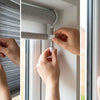
Clear the floor, get a proper stepladder, and rotate the sash into the cleaning position so it locks upside down. That brings the top of the frame to chest height and turns an awkward job into an ordinary one.
Fit the channels before the headrail, never after. Pre-start every screw while the sash is in front of you, and check the channels sit parallel before tightening, because a channel that leans pinches the fabric halfway down. Two people make this short. One makes it long.
When a Universal Blind Is Fine
Universal roof blinds exist, they function, and they look like what they are. They bracket onto the sash face rather than dropping into the manufacturer's rebate, so they stand a little proud and any channels are generic.
What you give up is neatness and some of the edge seal. What you get is a blind that needs no code hunt.
For a landing, a bathroom or a spare room, that trade is reasonable. For the room you sleep in, or a nursery, buy keylite blinds made for your frame. You notice the difference at first light, not at midday.
Roof lantern blinds are a separate problem, since a lantern is a faceted structure rather than one pivoting sash, and nothing built for a pitched roof window carries over. Where the code on your frame is readable, order against it. Where it is not, a universal blind keeps the room usable, and keylite blinds can replace it later.
Frequently asked questions
How do you fit velux blinds?
Rotate the sash and lock it in the cleaning position so the top of the frame is within reach. Fit the side channels first, pre-starting the screws while the frame is in front of you rather than overhead. Clip the headrail into its brackets, then run the fabric down and check it tracks squarely in both channels before tightening anything fully.
How do you measure for blinds?
For a standard window, measure the recess width at the top, the middle and the bottom, and the drop at both sides and the centre, then take the smallest of each. For a roof window, do not rely on measuring at all. Read the code on the sash and quote that, using your tape only to confirm the figure looks plausible.
How do you install blinds?
Work out first whether the blind fixes to the frame, inside the recess or on the face above it, because every bracket position follows from that choice. Mark both brackets off one level line rather than off the frame, which is rarely true. Fix the top, hang the blind, then check the drop clears handles before adding bottom fixings.