Skip to content


Clip In Conservatory Roof Blinds: Fitting Overhead Without Drilling the Glazing Bars
- by Mariam Labadze
Clip in conservatory roof blinds fix to the glazing bars with sprung clips instead of screws, so nothing pierces the sealed units above your head. You measure each sloped pane between the bars, order to a tight tolerance, then push the frame home. No drilling, no broken seals.
 The appeal is obvious the moment you picture a drill pointed at a double-glazed roof. Get it wrong and you crack a unit or void the glazing warranty. Clip in conservatory roof blinds remove that risk, but they only reward you if your measurements respect how a roof pane is actually built. The panes slope, they taper, and the aluminium bars either side are your only fixing points.
[toc]
Key Takeaways
-
Measure between the bars, never the glass: the clip frame seats inside the aluminium, so every figure runs from bar edge to bar edge.
-
Sloped panes taper, so take two widths: the top and bottom of a roof pane rarely match, and you work to the smaller reading.
-
Clips need a deduction to grip: leave the tolerance the maker specifies or the sprung clips have nothing to bite into.
-
No drilling protects the sealed unit: because nothing enters the glazing, the manufacturer warranty on your roof stays intact.
-
Treat it as a two-person job: holding a tape steady above your head while you read it is not a solo task.
Why Clip In Conservatory Roof Blinds Change the Whole Fitting Job
A standard blind is fitted to a flat face and screwed home. A roof pane gives you neither a flat face nor a screw you would want to use. That is why clip in conservatory roof blinds exist: the frame carries small sprung clips on its edges that grip the lip of the glazing bar, holding the blind flush to the underside of the glass.
Because the fixing is mechanical and reversible, you can lift a panel out to clean it and clip it straight back. The trade-off is precision. A screwed bracket forgives a few millimetres; a clip does not. If the panel is even slightly wide it will not seat, and if it is slightly narrow the clips lose their grip. Most conservatory blinds for the sides tolerate rough measuring far better than a roof blind ever will.
The Measurement Sequence for a Sloped, Tapered Pane
This is where people come unstuck, so work through it in order. First, measure the width at the top of the pane, bar edge to bar edge, then measure the width again at the bottom. On a Victorian or Edwardian roof these two figures almost always differ, because the panes narrow towards the ridge or splay towards the eaves.
Take the smaller of the two widths as your working width. A panel cut to the wider figure simply will not pass through the narrower end of the aperture. Next, measure the length down the slope of the glass, following the pane rather than the horizontal. Record which pane is which, because no two on a typical roof are identical and a blinds for conservatory roof order is made to each individual reading.
Write every figure on a numbered diagram of the roof before you order. A labelled sketch stops you transposing the third pane onto the fifth, which is the single most common ordering error on multi-pane roofs.
The Tolerance Clips Actually Need
Clips grip a lip, and a lip has a fixed depth. The maker publishes a deduction, often a few millimetres off the measured bar-to-bar width, and that gap is not slack to be trimmed out. It is the working room the sprung clip needs to compress as the panel goes in and spring back once it is home.
If you order to the exact aperture the panel binds and the clips cannot travel. If you over-deduct, the panel rattles and eventually drops. Follow the stated deduction to the millimetre for every pane, and check whether the tolerance differs for width and for length, because some systems quote two figures. Perfect fit systems built on the same clip principle behave the same way, which is why the perfect fit pleated blinds sold for windows carry their own deduction guidance rather than one blanket number.
Fitting Overhead, Step by Step
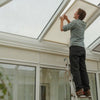
Set your access first. A stable platform that lets you reach the ridge without stretching beats a wobbly step every time, and a second person passing panels up saves both your arms and your accuracy. Start at the pane nearest the wall so you are always working towards open space rather than boxing yourself in.
Offer the panel up at a slight angle, engage the clips on one bar, then rotate the far edge until the opposite clips snap onto the second bar. You should hear and feel each clip seat. Run a hand along the frame to confirm it sits flush against the glass with no daylight gap at the corners. Conservatory ceiling blinds fitted this way should feel solid the instant they are home; if a panel shifts under light pressure, it is under-gripped and needs checking against your deduction.
Choosing the Fabric Before You Fit, Not After
Fabric choice is a measuring decision as much as a comfort one, because a heavier thermal weave and a light pleated cloth can carry slightly different frame depths. Decide early so the panels you measure for are the panels you actually order. The thermal blind fabrics used overhead are built to slow heat transfer through the glass, which matters more on a roof than on any vertical window.
This article is about getting the fit right, not about which fabric tames a south-facing roof in July, so if you are weighing performance we cover that separately in our guide to taming heat and glare overhead. Pleated conservatory blinds remain the usual roof choice because the concertina fabric holds its shape against gravity and packs tightly at the top rail when open.
Where Roof Blinds Differ From Skylight Blinds
People often assume a roof blind and a skylight blind are the same product, and they are close cousins rather than twins. A skylight sits in a single flat or lightly pitched aperture with a defined frame, whereas a conservatory roof is a run of tapering panes meeting at a ridge. The clip approach suits both, but the measuring discipline is stricter on the multi-pane roof.
If your project is actually a flat roof light or a loft window, the roof window blinds range is the closer match and the measuring is simpler, since you have one square-ish aperture rather than a fan of trapezoids. Knowing which one you have before you measure saves an ordering round-trip.
Common Fitting Mistakes to Avoid
The mistakes cluster in a few places. Measuring the glass instead of the bar gap gives you a panel that is too wide every time. Taking one width on a tapered pane and assuming it holds top to bottom gives you a panel that jams halfway. Ignoring the clip deduction gives you either a bind or a drop.
Two smaller ones catch people too. Mixing up numbered panes on the order, and fitting from the open end inwards so the last panel has no room to rotate into place. Work wall-first, label everything, and respect the deduction, and clip in conservatory roof blinds go up in an afternoon. When you are ready to order to your figures, the full conservatory blind range covers both the sloped roof panes and the side windows so the whole space is made to one set of readings.
Frequently asked questions
How do you clean conservatory blinds?
Lift each clip in panel out of its glazing bars, which is the whole point of the clip system, and clean it on a flat surface. Vacuum pleated and cellular fabric on a low setting with a soft brush head, then spot-clean marks with a barely damp cloth and mild soapy water. Let the fabric dry fully before you clip it back, and dust the bars while the pane is out.
How do you fit venetian blinds in a conservatory?
On the side windows, venetian blinds usually fit inside the frame using a perfect fit clip frame that grips the beading, so no drilling is needed. Measure each aperture bar to bar, order to the stated deduction, then clip the frame into the glazing rubber. For the sloped roof, venetians are rarely used because gravity pulls the slats out of true; pleated fabric holds its shape overhead far better.
Are thermal blinds worth it?
On a conservatory roof, yes, because most heat gain and loss happens through the glass above you rather than the walls. A thermal or cellular fabric traps a layer of air against the pane, slowing summer heat coming in and winter warmth escaping, which makes the room usable across more of the year. The gain is larger overhead than on a vertical window, so a roof is where the fabric earns its keep.