Skip to content


Cordless Vertical Blinds: How a Wand Replaces the Chain
- by Mariam Labadze
Cordless vertical blinds use a rigid wand to do both jobs the looped chain and cord used to do: twisting the wand tilts the louvres, and pushing or pulling it slides them along the track. There is no loop hanging down the wall, which is the whole point of them.
That swap works beautifully on a window and less well on a very wide run. Knowing where the line falls is the difference between a blind you enjoy and one you fight with every morning.
Key Takeaways
-
The chain does two jobs. Tilting the louvres and traversing them along the track are separate actions on the same control.
-
A wand does both by hand. Twist to tilt, push or pull to traverse, with nothing left hanging at the side.
-
Safety is the reason they exist. A loop at child height is the thing a wand removes, which is why most homes with young children choose one.
-
Width is the limit. Past a certain run, cordless vertical blinds become a two-handed push and the pleasure goes out of it.
-
A motor is the honest upgrade. For a very wide opening, powered operation beats any manual control and nobody selling wands says so.
What the Chain Actually Does
On a traditional vertical blind the control side carries two things: a continuous beaded chain that rotates the louvres on their carriers, and a cord that drags the carriers along the headrail. Pull one and the louvres turn in place. Pull the other and they travel.
That is more clever than it looks, because it lets you stand in one spot and do everything. It is also a loop of chain and a loop of cord hanging within reach of anything small in the room, which is why the whole cordless vertical blinds category exists. Safety is the motivation, and the engineering question that follows is simply how you replace two separate controls with one stick.
Worth being clear about what you give up. The chain is effortless on any width, because you are pulling a loop over a geared wheel rather than pushing the louvres themselves. Cordless blinds ask your arm to do the work the gearing used to do.
How a Wand Replaces Both Jobs
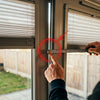
The wand hangs from the first carrier and connects to the tilt rod running the length of the headrail. Twist it and the rod turns every carrier at once, so the louvres rotate together exactly as they would on a chain. That half of the job is a direct swap and feels no different.
The traverse is the part that changes. On cordless vertical blinds there is no cord pulling the carriers, so you push the wand sideways and the first carrier drags the rest along behind it through their spacers. On a normal window that is one easy movement. Across the vertical blinds range the carriers and spacers are the same parts whether the control is a chain or a wand, so the mechanism is not more fragile, just more manual.
One practical note on direction. The wand sits at the stacking end, so if you want it on the left the blind has to stack left, and that is a decision made when the headrail is built rather than afterwards. Think about which side you will stand on before you order.
Where a Wand Stops Being Comfortable
Here is the thing nobody mentions in a product description. On cordless vertical blinds every louvre you add puts more weight on the push, and on a long track the last few carriers reach you as resistance through a stick you are holding at arm's length. On a standard window it is nothing. On a patio door it is noticeable. On a run across a whole wall it becomes a two-handed job, and you find yourself walking the blind along in stages.
Fabric weight compounds it. A heavy dim-out or a blackout louvre is a heavier carrier, so cordless blackout blinds in a wide opening feel stiffer than a light voile in the same width. Cordless vertical blinds are only as easy as their heaviest fabric. Cold mornings make it worse, because the spacers stiffen slightly before the room warms up.
If your opening is genuinely wide, the honest answer is not a better wand. It is motorised blinds, where a motor in the headrail does the traverse and the tilt and there is nothing at child height either. That costs more and it needs power at the window, and for a wide patio door it is still the control most people end up happier with.
Cordless Vertical Blinds and Child Safety
The motivation is simple and it does not need labouring: a hanging loop is a hazard in a room where small children play, and removing it removes the hazard. Cordless vertical blinds do that by design rather than by adding a cleat or a breakaway part you have to remember to use.
The same logic drives cordless roller blinds, where a spring mechanism replaces the side chain, and it is worth noticing that the two products solve the problem differently. A roller stores energy in a spring. A vertical blind cannot, because the louvres have to stop anywhere along the track and stay there, so the wand stays manual.
Damage is the other thing worth planning for. Wands get grabbed, louvres get pulled, and a single split slat is not a reason to replace a blind when replacement vertical blind slats can be hung on the existing carriers in minutes. Buy cordless vertical blinds for the rooms where a loop would worry you, buy a motor for the opening too wide to push by hand, and keep a spare louvre or two for the rooms where things get knocked.
Frequently asked questions
How do cordless blinds work?
They replace a pulled loop with a control you move directly. On a vertical blind a rigid wand twists to tilt the louvres and pushes sideways to traverse them along the headrail. On a roller, a spring inside the tube balances the fabric so it stays where you leave it. On both, the result is the same: no chain or cord hanging within reach, and the mechanism moved inside the blind or into your hand.
How do cordless venetian blinds work?
The slats are raised and lowered by lifting the bottom bar by hand, with a friction or spring mechanism inside the headrail holding the blind at whatever height you release it. Tilt is handled separately, usually by a wand on the control side. There is no lift cord running down the wall, so the blind has to be reached directly, which matters on a tall window.
What are cordless blinds?
Any blind operated without a hanging cord or chain loop. The category covers wand-operated vertical blinds, spring-balanced rollers, push-up venetians and motorised versions of all three. They are chosen mainly for safety in homes with young children and for the cleaner look of a window with nothing dangling beside it. Operation is by hand or by motor, depending on the type and the width.