Skip to content

Kitchen Shutter Blinds: What Steam, Grease and a Sink Do to a Louvre
- by Mariam Labadze
Kitchen shutter blinds have to survive the most hostile room in the house, and the thing that wears them out is not the steam. It is the grease, because every louvre is a horizontal shelf in a room where fat gets vaporised most evenings.
That does not rule shutters out of a kitchen. It rules them out of one particular window, and it changes which material you order.
Key Takeaways
-
Grease, not steam, is the enemy. Airborne fat settles on every upward facing blade and dulls the finish.
-
Material decides survival. Moisture tolerant panels hold their shape where timber can swell and stick.
-
The sink window is the exception. Daily splashes beat any louvre, whatever it is made from.
-
Cleaning is a schedule. Kitchen shutter blinds wipe clean easily, but only before the film hardens.
-
Shutters win everywhere else. Away from the sink and the hob, they outlast fabric comfortably.
Why Kitchen Shutter Blinds Need a Different Material
Shutter panels come in timber, in engineered board with a sprayed finish, and in moulded polymer. In a living room that choice is about looks and budget. In a kitchen it is about what the air does twice a day.
Timber moves with moisture. It takes on water from damp air, swells slightly across the grain, then gives it back when the heating comes on, and that cycle shows up as louvres catching in their pins and a frame that no longer closes sweetly. Wooden shutter blinds in a well ventilated kitchen are usually fine. In a small galley with the kettle under the window, they are a gamble.
Moisture tolerant panels are the safer order for kitchen shutter blinds, because they do not take on water. They are heavier than timber, so a wide window may need an extra panel. Check what a range offers in this material before committing to a style.
Finish matters as much as substrate on kitchen shutter blinds. A smooth, sealed surface releases grease with a cloth, while a textured or open grained one holds it, and across the shutter blinds uk market that is rarely spelled out on a product page.
The Window Over the Sink Is the Hard One
One window in every kitchen takes the punishment, and it is almost always the one above the sink. Water lands on it from the tap, from rinsing, from a pan tipped carelessly, daily for years.
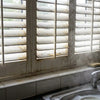
A shutter frame sits proud of the glass with a bottom rail just above the sill, and that rail is a trough. Splashed water runs down the panel, gathers there and sits until someone notices. On timber that is the start of a lifted edge.
Tilting the louvres to drain is no fix, because the pins and the linkage are exactly where water collects. It is the same argument that sends people to waterproof bathroom blinds for a shower room, and it carries across to a sink.
Honest conclusion: put kitchen shutter blinds on the other windows and something wipeable above the sink. A fitter who says the sink window is no different has not been back to see one after two winters.
Grease Settles on Horizontal Surfaces
Frying sends fat into the air as a fine aerosol. It drifts, cools and lands on the first flat surface it meets, which is why the tops of wall units go sticky and the undersides do not.
A shutter presents a row of flat surfaces at every height of the window. Closed, the blades lie at an angle and catch less. Left tilted open through the day, which is how most people use them, every louvre is a ledge. Kitchen shutter blinds collect more residue than any other covering in the room, simply because there is more upward facing surface.
Distance from the hob is the variable you control. A window on the far wall of a kitchen diner picks up a fraction of what one beside the extractor does.
Cleaning a Louvre Without Taking It Apart
The job is easy while the film is soft and hard once it has set into varnish. That fact should set your cleaning interval, not the calendar.
Work blade by blade with a dry microfibre cloth first, along the louvre rather than across it, to lift dust before anything wet goes near. Then tilt the panel halfway and go over the greasy blades with a cloth wrung out in warm water and a drop of washing up liquid.
Two things to avoid. Do not soak the panel, because water in the pin holes is how a hinge starts squeaking and a timber blade starts lifting. And do not spray cleaner at the shutter, since the overspray goes into the frame and the linkage rather than the blade you were aiming at.
Kitchen shutter blinds reward a quick pass every few weeks far more than a deep clean twice a year. The deep clean is the one that scratches something.
Where a Wipe Clean Blind Beats a Shutter
Above a sink, a flat surface wins. A smooth fabric has one plane to wipe instead of a stack, and takes a cloth in one pass. Most of the roller blinds chosen for kitchens are picked for that reason rather than for looks.
Slatted blinds sit between the two. A set of venetian blinds gives the same tilt control and the same horizontal ledges, but it comes off its brackets for a proper clean, which a fixed panel never will. That is why so many kitchen window blinds end up as venetians rather than shutters.
Cost pushes the same way. Kitchen shutter blinds are the most expensive thing on the list, and a sink window is the worst place for it. Most of the kitchen blinds uk buyers fit get chosen for replaceability.
Away from the water and the hob, the argument flips. On a side window, or a kitchen diner window at the far end of the room, kitchen shutter blinds look better than anything else, hold their shape and take a wipe when the room needs it. Match the covering to the window rather than to the room and you get both.
Frequently asked questions
Are shutter blinds suitable for kitchens?
Yes, with two conditions. Choose a moisture tolerant panel rather than untreated timber, and keep the shutter away from the window directly over the sink. On every other window in the room a shutter handles the humidity without complaint, provided the extractor works and the room dries out between meals. The maintenance you are signing up for is wiping the blades, not repairing them.
How do you clean shutter blinds?
Dust first with a dry microfibre cloth, running it along the blade rather than across, then tilt the panel halfway so both faces are within reach. For grease, use a cloth wrung out in warm water with a little washing up liquid and finish with a dry one. Keep moisture out of the pin holes and the hinges, and leave abrasives and sprays well away from a painted finish.
How do you fix shutter blinds?
Most faults are small. A louvre that will not hold its angle has a slackened tension screw in the hinge side of the frame, which tightens by hand. A panel catching its frame usually means the hinges have dropped, so the screws need checking before anything else. A blade that has come off its pin can often be eased back without removing the panel.