Skip to content


Panel Track Blinds: The Wide-Opening Alternative to Vertical Louvres
- by Mariam Labadze
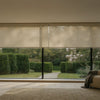
 Panel track blinds are a wide-slat blind system where large fabric panels glide along a headrail and stack neatly to one side, clearing a wide window or door in a single sweep. They suit sliding patio doors and picture windows where a traditional louvre would feel busy. The panels are broad, flat and quiet.
[toc]
That last point matters more than most people expect. A vertical louvre is made of many narrow slats that rattle and twist; panel track blinds replace them with a handful of large sections that move as one calm unit. If you have a wide opening and want a cleaner face, this is the format that claims the space.
Key Takeaways
-
Panels stack, they do not fold: each section slides behind the next along the track, so the full stack sits compactly at one end rather than bunching in the middle.
-
Panel width sets the look: wider panels give a smoother, more modern face with fewer joins, while narrower panels give you more control over partial coverage.
-
Track carriers do the work: the number of channels in the headrail decides how many panels you can run and which way they stack.
-
They shine on sliding doors: for patio doors and glazed walls, panel track blinds clear the opening cleanly where louvres would drag.
-
Comparison lives elsewhere: if you are weighing them against louvres, read the dedicated vertical vs panel track piece before you decide.
How the track actually works
The headrail is the whole system. Inside it sits a set of channels, and each channel carries one panel on a small runner. When you pull the wand or cord, the lead carrier moves first, then collects the next carrier, then the next, so the panels gather in sequence rather than all at once.
That sequential stack is why the format feels so tidy. You are not gathering loose slats; you are sliding rigid sections along fixed lines. A three-channel track gives you three panels, a five-channel track gives you five, and the channel count is the first thing to check when you plan coverage for a wide opening.
Most tracks let you choose which end the stack lands on, or split it so half the panels park left and half park right. For a central sliding door, a split stack means you can open from the middle and push the fabric out to both jambs. This is one of the more useful patio door blinds ideas for rooms where the door is the main route to the garden.
Panel widths and how to choose them
Panel width is the decision that defines the finished face. Broad panels, often around 40 to 60 centimetres each, give you long clean verticals and very few joins across the glass. Narrower panels give you more sections, which means finer steps when you want to cover only part of the window.
Think about how you actually use the opening. A wall of glass that you rarely part in the middle looks best with wide panels and a clean stack to one side. A door you open several times a day may be easier to live with when the panels are a little narrower, so a single pull clears just the leaf you use.
There is a fabric point here too. Because the panels are wide and flat, the material shows itself honestly, so a textured weave or a soft dim-out reads well across the surface. If you want a comparable flat look on a smaller window elsewhere in the room, our roller blind range uses the same principle of a single tensioned face rather than many moving parts.
The stack: where the fabric goes when you open
The stack is the pile of panels once they are drawn back, and its depth is the trade-off you accept for a wide opening. Each panel sits behind the last, so a five-panel track parks a deeper stack than a three-panel one. Measure the wall or reveal beside your glass to be sure the stack has somewhere to live.
Where a louvre gathers into a soft bundle, panel track blinds park as a flat, shallow bank of fabric. On a sliding patio door this is a real advantage, because the stack clears the glass you want to walk through instead of hanging across it. For blinds for sliding glass doors, that clean clearance is usually the whole point.
If you are fitting to a recess, remember the stack still needs its depth inside the reveal. Fit outside the recess on a wide face and the stack simply sits against the wall, which most people find easier on very broad openings.
Panel track versus vertical louvres
This is the comparison everyone asks about, and it deserves its own space rather than a rushed paragraph. In short, louvres give you tilt for fine light control across the day, while panel track blinds give you a cleaner face and a calmer opening. Neither is simply better; they solve different problems.
Vertical louvres let you angle the slats, so you can keep the panels closed but twist them to let a slice of light through. Panel track has no tilt; you cover or you clear, and the in-between is about how far you draw the panels. If tilt control is the feature you care about, vertical blinds remain the honest choice for that job.
Because the arguments run deep on cost, cleaning and light control, we have set them side by side in one place. Read vertical vs panel track, compared before you commit, especially if your opening could take either format.
Living with panel track over time
Day to day, this is a low-fuss system. There are no dozens of slats to straighten after a gust from an open window, and the panels wipe down as flat surfaces rather than fiddly strips. A quick pass with a soft brush along each panel keeps the weave clean.
Repairs are simpler than they look. Panels lift out of their carriers individually, so a single damaged section comes off without touching the rest of the track. That is easier than a louvre setup, where a torn strip usually means hunting down matching replacement vertical blind slats to keep the set uniform.
Over years of use, the track is the part that earns its keep. Keep the runners free of grit, and the panels will keep gliding without the twist and snag that narrow louvres develop. It is a quieter system to own, and on a wide sliding patio door that quiet counts for a lot.
Which openings suit panel track best
Panel track blinds are built for width. They come into their own on sliding patio doors, bi-folds, glazed corners and long picture windows, the openings where a narrow-slat louvre would look restless and drag as it gathers. If your glass is wider than it is tall, this format was made for it.
They are less suited to small standard windows, where the headrail and stack are more system than the opening needs. On a modest window, a flat single blind does the job with less hardware. Save panel track for the sliding patio door blinds moment, the wall of glass that opens to the garden and needs a clean, wide sweep.
Think about traffic too. If a door is your main way in and out, a split stack that parts in the middle keeps the fabric out of your path. That combination of width and daily use is exactly where panel track earns its place, so browse the full patio door blind range to see the panels, tracks and fabrics side by side before you measure your own glass.
Frequently asked questions
How much are vertical blinds?
The price of vertical blinds depends on the width of the track, the number of louvres, the fabric you choose and any dim-out or waterproof finish. A small kitchen window costs far less than a wide patio run, because the wider track needs more slats and a longer headrail. For an accurate figure, measure your opening first, then price the exact size and fabric rather than working from a generic estimate, since width is the main driver of the final cost.
How do you fit vertical blinds?
You fix the headrail with brackets, either into the top of the recess for an inside fit or onto the wall above for an outside fit. Level the rail, clip it into the brackets, then hang each louvre onto its carrier and connect the bottom chain or weights. Check the slats rotate freely and hang straight before you trim any cords. Take care to set the brackets evenly, because an uneven rail is the usual cause of louvres that twist or catch.
Are roller blinds suitable for doors?
Roller blinds can work on doors, but with limits worth knowing. On a hinged door they need mounting clear of the handle and the swing, and the fabric should be tensioned so it does not flap as the door moves. On a wide sliding door a single roller becomes very large and heavy, which is where a wide-panel format usually serves you better. For narrower door lights and side panels, a roller is a neat, flat solution.