Skip to content


Perfect Fit Blinds for Bifold Doors: Blinds That Fold With the Door
- by Mariam Labadze
Perfect fit blinds for bifold doors clip flat into the glazing bead of each leaf, the only arrangement that lets the doors still fold back on themselves. Depth decides everything here. A bifold parks leaf against leaf, and anything standing proud of the glass is what stops the stack closing.
That is the design problem in one line. Perfect fit blinds for bifold doors have to be thinner than the air left between two parked leaves, and that gap is smaller than most people assume.
Key Takeaways
-
Every leaf needs its own blind. The doors fold against each other, so one wide blind across the top is not an option.
-
Thin beats everything. Frame projection, not fabric choice, decides whether the doors still stack and lock.
-
Hinges eat the edges. The hinge side of each leaf is where frame and ironmongery argue.
-
Handles need checking twice. Perfect fit blinds for bifold doors meet a lever on the traffic door and flush pulls on the slave leaves.
-
Cost scales with leaves. A six leaf run is six made to measure blinds, and the quote reflects that.
Why Anything Hanging Above a Bifold Fails
A bifold is not one door, it is a concertina. Open it and the leaves swing, fold and travel sideways to park in a stack at one end, so the space in front of the glass is in constant use.
Most blinds for bifold doors get mounted above the opening on one long headrail, and that is where they come undone. A fabric hanging in front of the leaves sits in the path of the fold, so it must be drawn right back before the doors move, and then it is a bundle parked over the part you wanted clear.
Curtains are worse, because the stack of a bifold lands exactly where a curtain wants to gather. perfect fit blinds for bifold doors avoid the argument by attaching to the glass itself: the blind folds when the door folds, and there is never anything to shift first.
How Perfect Fit Blinds for Bifold Doors Stay Flat
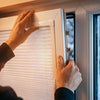
The frame is a shallow rectangle that clips into the rubber bead around each pane. Nothing is drilled into the door, which matters on aluminium and in a rented house alike. Because the frame sits inside the bead, the blind is held within the thickness of the leaf instead of projecting into the room.
That flatness is the trick. perfect fit blinds were designed for uPVC windows that tilt and turn, so holding a fabric steady against moving glass is the problem the system was built around. A bifold asks the same question several times over.
Perfect fit blinds for bifold doors also keep the fabric under tension top and bottom. A loose blind on a swinging leaf would knock against the frame every time the door moved. A tensioned one does not, which is why the format suits doors better than almost anything else.
Stacking: Where the Leaves Park Against Each Other
Here is the measurement to take before ordering. Fold the doors fully open and look at the gap between two parked leaves. Perfect fit blinds for bifold doors live or die on that space, because it has to swallow two frames, one on each facing pane, with room left over.
On most systems the leaves never touch, since the handles and hinge knuckles hold them apart. That hardware gap is your working allowance. Ask what the frame projects beyond the bead, then set it against what you measured.
If the sums are tight, blind alternate leaves. Half the glass shaded is a genuine compromise and still better than doors that no longer close. Perfect fit blinds for bifold doors are not worth a door that fouls.
The Handle and Hinge Clearance Check
Handles are the first obstacle. The traffic door carries a full lever and often a key barrel, and the slave leaves carry flush pulls that still stand proud of the glass. The leaf that opens on its own is rarely hung like the rest.
Measure from the edge of the glass to the nearest hardware on every leaf, and write it down leaf by leaf. Doors that look identical rarely are, and perfect fit blinds for bifold doors are made to each pane, so one transposed figure means a blind that will not clip in.
Hinges matter in the other direction. The knuckles rotate through the space beside the glass as the door folds, so a frame running right to the edge on the hinge side can catch as the fold begins. Sliders avoid this, which is one reason patio door blinds are an easier job than bifolds.
Where the hardware wins, ask about a cut-out. It works, and it leaves a notch of unshaded glass, worth weighing if you were considering perfect fit blackout blinds for a snug.
Costs That Multiply With Every Leaf
This is the part the showroom photograph hides. Perfect fit blinds for bifold doors are quoted per leaf, so a three leaf door is three made to measure blinds and a six leaf run is six.
The panes on a bifold are tall and narrow, the least economical shape to buy made to measure. Most perfect fit blinds uk suppliers price on area, so a run of narrow leaves asks more of the budget than one wide window covering the same wall.
Where the money will not stretch, two routes make sense. Shade the leaves that face the sun and leave the rest clear, which on a west facing run covers the hours that matter. Or put a track above the opening and hang vertical blinds across it, the oldest of the blinds for bifold doors answers, accepting they must be drawn fully back before the doors fold.
Set against that multiplication, the per leaf approach buys something no track can. Perfect fit roller blinds and pleated fabrics in a clip-in frame leave the doors working as they did before, with nothing overhead to gather. Perfect fit blinds for bifold doors are the only format that disappears into the door, and on a run you open every day that is usually the argument that settles it.
Frequently asked questions
How do you fit perfect fit blinds?
You clip them to the glass. The frame is built around the pane, then the brackets are pushed into the rubber bead that holds the glazing, and the bead grips them without a single screw going into the door. Press each bracket home in turn until the frame sits flat. On a bifold, open and fold the doors once before you call the job finished.
How do you fit blinds?
It depends where they go. A recess blind needs brackets screwed into the top or the sides of the reveal, level and square, before the headrail clips in. A face fitted blind screws above the opening instead. A clip-in frame needs no screws at all, which is the reason it suits doors, aluminium frames and rented homes where drilling is not allowed.
How do you remove perfect fit blinds?
Work the brackets out of the bead. Start in one corner with a thin blade or the plastic tool the supplier sends, lever the bracket gently away from the rubber, and release a full side before lifting the frame off. Keep the frame assembled so it can go back on later. The glazing bead closes up again and the leaf is left unmarked.