Skip to content


How to Fit Roman Blinds: Step-by-Step UK Guide
- by 1ClickBlinds
To fit a roman blind, decide whether it goes inside the window recess (top fix) or on the wall above it (face fix), mark the bracket positions on a level line, drill and plug the holes, and screw the brackets in place. Then clip the headrail into the brackets, attach the fabric if it comes separately, fit the child safety device for the cord or chain, and raise and lower the blind a few times to check it runs straight. Most people can fit one in 30 to 60 minutes with a drill, a spirit level and a pencil.
Roman blinds look like a job for a professional, but they go up in much the same way as any other blind: two or three brackets, a headrail and a few screws. The part that takes care is getting the brackets level and in the right place, because a fabric blind shows every wonky millimetre. This guide walks you through fitting a roman blind inside a recess and on the wall, with the tools you need and the mistakes to avoid.
Before you start: top fix or face fix?
How you fit the blind depends on where it was measured to go. Check your order or the label on the blind before you drill.
| Top fix (recess fit) | Face fix (exact or face fit) | |
|---|---|---|
| Where the blind sits | Inside the window opening | On the wall or frame above the opening |
| Brackets screw into | The ceiling of the recess | The wall above the window |
| Look | Neat and built in | Covers the whole opening, can make a window look bigger |
| Light around the edges | A small gap at each side | Less light gets round the edges |
| Best for | Deep recesses | Shallow recesses, or when you want more darkness |
Not measured yet? Read our guide to measuring for made to measure roman blinds first, as the fit type decides everything else.
What you need
- The blind, brackets and fixings that came with it
- A drill and drill bits for your wall type
- Wall plugs suited to the wall (masonry, plasterboard or timber)
- A screwdriver
- A spirit level
- A pencil and a steel tape measure
- A stepladder
- A detector to check for hidden pipes and cables
Tip: lay all the parts out and read the instructions that came with your blind before you start. Fittings differ between suppliers and blind types, so follow those first.
How to fit a roman blind inside a recess (top fix)
- Check for pipes and cables. Run a detector along the top of the recess before you mark anything.
- Mark the bracket positions. Hold the headrail up to the top of the recess, centred, and mark where the brackets will go. Place one bracket near each end of the headrail, a few centimetres in, and add a middle bracket on wider blinds.
- Keep them in line. Make sure all the marks are the same distance from the front edge of the recess, so the blind hangs straight and clears the window handles.
- Drill and plug. Drill the holes, push in the wall plugs and screw the brackets up into the recess ceiling. Do not fully tighten until all brackets are in.
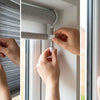
- Clip in the headrail. Push the headrail into the brackets until it clicks or locks in place. Pull gently to check it is secure.
- Attach the fabric. If the fabric is separate, line it up along the front of the headrail and press it on firmly from the centre outwards, so it sits straight.
- Fit the safety device and test. Fit the cord or chain safety device (see below), then raise and lower the blind a few times.
How to fit a roman blind on the wall (face fix)
- Find the centre. Measure the width of the window opening and mark its centre on the wall above.
- Draw a level line. Use the spirit level to draw a light pencil line where the top of the headrail will sit. Leave space above the opening so the folded fabric (the stack) sits mostly above the glass when the blind is raised.
- Mark the brackets. Hold the headrail on the line, centred, and mark the bracket positions near each end, plus one in the middle for wider blinds.
- Check for pipes and cables, then drill, plug and screw the brackets to the wall.
- Clip in the headrail and attach the fabric if it comes separately.
- Fit the safety device and test the blind a few times.
Fitting the child safety device
Looped cords and chains can be dangerous for young children. Blinds sold in the UK must meet child safety standards, and they come with a safety device for the cord or chain. Always fit it.
- Chain tensioner: fix it to the wall or frame so the chain is held tight and cannot form a loose loop.
- Cord cleat: fix it high up, out of children's reach, and wind the cord round it every time you raise the blind.
- Keep furniture away: do not place cots, beds or chairs where a child could climb up to the cord.
Common fitting problems and how to fix them
| Problem | Likely cause | Fix |
|---|---|---|
| The blind hangs at an angle | Brackets are not level | Loosen the brackets, check with a spirit level and refit |
| Folds stack unevenly | Fabric not straight on the headrail, or cords uneven | Lower the blind fully, re-attach the fabric from the centre out |
| The blind catches on the window handle | Brackets too close to the glass | Move the brackets forward in the recess |
| Fabric rubs on the sides of the recess | Blind not centred | Re-centre the headrail in the brackets |
| Screws will not hold | Wrong plugs for the wall | Use plasterboard or masonry fixings that match your wall |
| Too much stack covering the glass | Face-fit blind mounted too low | Refit the brackets higher above the opening |
Can you fit a roman blind without drilling?
Yes, on some windows. No drill fittings use tension or clip-on brackets that hold the headrail without screws, which suits renters and uPVC windows. Because a roman blind is heavier than a roller blind, check the size and weight limits for the fitting before you buy. See our no drill blinds for options.
Fitting a roman blind in a bay window
A bay window usually needs one blind per window panel, each fitted on its own brackets, so the blinds can open and close separately. Mark all the panels before you drill so the headrails line up at the same height. Our guide to roman blinds for bay windows covers measuring and fitting each angle.
Looking after your roman blind once it is fitted
- Raise and lower it by the cord or chain, not by pulling the fabric.
- Lower it fully now and then so the folds do not set in one place.
- Dust it regularly with a soft brush attachment. See how to clean roman blinds for each fabric.
Ready to choose? Browse our made-to-measure roman blinds in plain weaves, velvet, chenille, boucle and patterned fabrics.
Frequently asked questions
How do you fit a roman blind?
Mark the bracket positions on a level line, drill and plug the holes, screw in the brackets, clip the headrail into them, attach the fabric if needed, fit the child safety device and test the blind.
Is it easy to fit a roman blind yourself?
Yes. If you can use a drill and a spirit level, you can fit a roman blind. Most take 30 to 60 minutes, and a second person to hold the headrail makes it easier.
How many brackets does a roman blind need?
Usually two, one near each end of the headrail. Wider blinds often need a third bracket in the middle to stop the headrail bowing. Use the brackets supplied with your blind.
Where should roman blind brackets go?
For a recess fit, on the ceiling of the recess, a few centimetres in from each end of the headrail. For a face fit, on the wall above the window, on a level line, with enough space above the glass for the folded fabric.
How high above the window should a roman blind go?
For a face fit, mount it high enough that the folded stack sits mostly above the glass when the blind is raised, so it does not block the light.
Can I fit a roman blind on a uPVC window frame?
Yes, but drilling into uPVC frames can damage them and may affect a window warranty. Fitting into the wall or recess, or using a no drill fitting, is usually a better choice.
Why is my roman blind not folding evenly?
The fabric may not be straight on the headrail, or the brackets may not be level. Lower the blind, check the headrail with a spirit level and re-attach the fabric from the centre outwards.
Do I need to fit the child safety device?
Yes. Always fit the cord cleat or chain tensioner supplied with your blind, and keep cords and chains out of children's reach.